

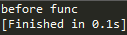
测试1
deco运行,但myfunc并没有运行
def deco(func):
print 'before func'
return func
def myfunc():
print 'myfunc() called'
myfunc = deco(myfunc)
</div>
测试2
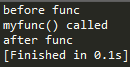
需要的deco中调用myfunc,这样才可以执行
def deco(func):
print 'before func'
func()
print 'after func'
return func
def myfunc():
print 'myfunc() called'
myfunc = deco(myfunc)
</div>
测试3
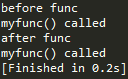
@函数名 但是它执行了两次
def deco(func):
print 'before func'
func()
print 'after func'
return func
@deco
def myfunc():
print 'myfunc() called'
myfunc()
</div>
测试4
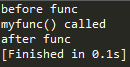
这样装饰才行
def deco(func):
def _deco():
print 'before func'
func()
print 'after func'
return _deco
@deco
def myfunc():
print 'myfunc() called'
myfunc()
</div>
测试5
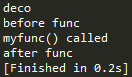
@带参数,使用嵌套的方法
def deco(arg):
def _deco(func):
print arg
def __deco():
print 'before func'
func()
print 'after func'
return __deco
return _deco
@deco('deco')
def myfunc():
print 'myfunc() called'
myfunc()
</div>
测试6
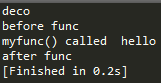
函数参数传递
def deco(arg):
def _deco(func):
print arg
def __deco(str):
print 'before func'
func(str)
print 'after func'
return __deco
return _deco
@deco('deco')
def myfunc(str):
print 'myfunc() called ', str
myfunc('hello')
</div>
测试7
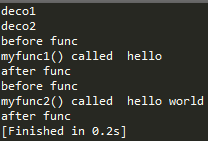
未知参数个数
def deco(arg):
def _deco(func):
print arg
def __deco(*args, **kwargs):
print 'before func'
func(*args, **kwargs)
print 'after func'
return __deco
return _deco
@deco('deco1')
def myfunc1(str):
print 'myfunc1() called ', str
@deco('deco2')
def myfunc2(str1,str2):
print 'myfunc2() called ', str1, str2
myfunc1('hello')
myfunc2('hello', 'world')
</div>
测试8
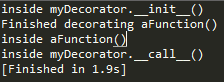
class作为修饰器
class myDecorator(object):
def __init__(self, fn):
print "inside myDecorator.__init__()"
self.fn = fn
def __call__(self):
self.fn()
print "inside myDecorator.__call__()"
@myDecorator
def aFunction():
print "inside aFunction()"
print "Finished decorating aFunction()"
aFunction()
</div>
测试9
class myDecorator(object):
def __init__(self, str):
print "inside myDecorator.__init__()"
self.str = str
print self.str
def __call__(self, fn):
def wrapped(*args, **kwargs):