通过本文主要向大家介绍了python heapq,python中的heapq,heapq,heapq.heappush,heapq.nlargest等相关知识,希望对您有所帮助,也希望大家支持linkedu.com www.linkedu.com
heapq 模块提供了堆算法。heapq是一种子节点和父节点排序的树形数据结构。这个模块提供heap[k] <= heap[2*k+1] and heap[k] <= heap[2*k+2]。为了比较不存在的元素被人为是无限大的。heap最小的元素总是[0]。
打印 heapq 类型
import math
import random
from cStringIO import StringIO

def show_tree(tree, total_width=36, fill=' '):
   output = StringIO()
   last_row = -1
   for i, n in enumerate(tree):
     if i:
       row = int(math.floor(math.log(i+1, 2)))
     else:
       row = 0
     if row != last_row:
       output.write('\n')
     columns = 2**row
     col_width = int(math.floor((total_width * 1.0) / columns))
     output.write(str(n).center(col_width, fill))
     last_row = row
   print output.getvalue()
   print '-' * total_width
   print
   return

data = random.sample(range(1,8), 7)
print 'data: ', data
show_tree(data)
</div>
打印结果
data: [3, 2, 6, 5, 4, 7, 1]

     3
  2      6
5    4  7     1
-------------------------
heapq.heappush(heap, item)
</div>
push一个元素到heap里, 修改上面的代码
heap = []
data = random.sample(range(1,8), 7)
print 'data: ', data

for i in data:
  print 'add %3d:' % i
  heapq.heappush(heap, i)
  show_tree(heap)
</div>
打印结果
data: [6, 1, 5, 4, 3, 7, 2]
add  6:
         6
 ------------------------------------
add  1:
      1
   6
------------------------------------
add  5:
      1
   6       5
------------------------------------
add  4:
        1
    4       5
  6
------------------------------------
add  3:
        1
    3       5
  6    4
------------------------------------
add  7:
        1
    3        5
  6    4    7
------------------------------------
add  2:
        1
    3        2
  6    4    7    5
------------------------------------
</div>
根据结果可以了解,子节点的元素大于父节点元素。而兄弟节点则不会排序。
heapq.heapify(list)
将list类型转化为heap, 在线性时间内, 重新排列列表。
print 'data: ', data
heapq.heapify(data)
print 'data: ', data

show_tree(data)
</div>
打印结果
data: [2, 7, 4, 3, 6, 5, 1]
data: [1, 3, 2, 7, 6, 5, 4]

      1
   3         2
7    6    5    4
------------------------------------
heapq.heappop(heap)
</div>
删除并返回堆中最小的元素, 通过heapify() 和heappop()来排序。
data = random.sample(range(1, 8), 7)
print 'data: ', data
heapq.heapify(data)
show_tree(data)

heap = []
while data:
  i = heapq.heappop(data)
  print 'pop %3d:' % i
  show_tree(data)
  heap.append(i)
print 'heap: ', heap
</div>
打印结果
data: [4, 1, 3, 7, 5, 6, 2]

         1
    4         2
  7    5    6    3
------------------------------------

pop  1:
         2
    4         3
  7    5    6
------------------------------------
pop  2:
         3
    4         6
  7    5
------------------------------------
pop  3:
         4
    5         6
  7
------------------------------------
pop  4:
         5
    7         6
------------------------------------
pop  5:
         6
    7
------------------------------------
pop  6:
        7
------------------------------------
pop  7:

------------------------------------
heap: [1, 2, 3, 4, 5, 6, 7]
</div>
可以看到已排好序的heap。
heapq.heapreplace(iterable, n)
删除现有元素并将其替换为一个新值。
data = random.sample(range(1, 8), 7)
print 'data: ', data
heapq.heapify(data)
show_tree(data)

for n in [8, 9, 10]:
  smallest = heapq.heapreplace(data, n)
  print 'replace %2d with %2d:' % (smallest, n)
  show_tree(data)
</div>
打印结果
data: [7, 5, 4, 2, 6, 3, 1]

         1
    2         3
  5    6    7    4
------------------------------------

replace 1 with 8:

         2
    5         3
  8    6    7    4
------------------------------------

replace 2 with 9:

         3
    5         4
  8    6    7    9
------------------------------------

replace 3 with 10:

         4
    5         7
  8    6    10    9
------------------------------------
</div>
heapq.nlargest(n, iterable) 和 heapq.nsmallest(n, iterable)
返回列表中的n个最大值和最小值
data = range(1,6)
l = heapq.nlargest(3, data)
print l     # [5, 4, 3]

s = heapq.nsmallest(3, data)
print s     # [1, 2, 3]
</div>
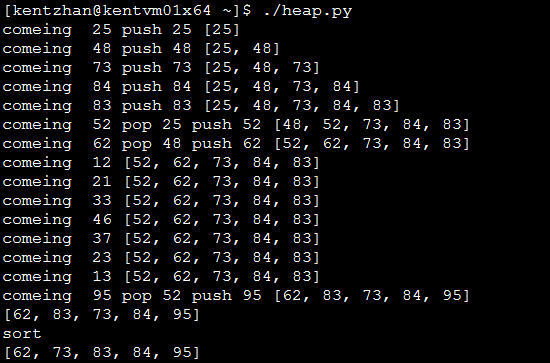
PS:一个计算题
构建元素个数为 K=5 的最小堆代码实例:
#!/usr/bin/env python
# -*- encoding: utf-8 -*-
# Author: kentzhan
#

import heapq
import random

heap = []
heapq.heapify(heap)
for i in range(15):
 item = random.randint(10, 100)
 print "comeing ", item,
 if len(heap) >= 5:
  top_item = heap[0] # smallest in heap
  if top_item < item: # min heap
   top_item = heapq.heappop(heap)
   print "pop", top_item,
   heapq.heappush(heap, item)
   print "push", item,
 else:
  heapq.heappush(heap, item)
  print "push", item,
 pass
 print heap
pass
print heap

print "sort"
heap.sort()

print heap
</div>
结果: